An environmental learning and action programme launched at two Kimberley primary schools during Youth Month this year is now moving from classroom lessons into real, hands-on projects — with learners at Beacon Primary School building a recycling and upcycling enterprise, and learners at Waterworks Primary School growing a food garden and fruit orchard to feed their own school feeding scheme.
Income generated from the enterprises is being reinvested by the programme into tools and equipment, helping ensure the green businesses can sustain themselves going forward.
At Waterworks Primary, learners have begun preparing the land for planting, scheduled for mid-October. Early yields of leafy greens and root vegetables are expected before other vegetables and fruit trees establish, and a first harvest is anticipated later this year. Produce will go first to the school’s feeding scheme, with any surplus potentially sold to parents, community members, teachers and local shops. Income from the garden will be used by teacher coordinators and programme committee members to buy additional tools, seeds and compost.
Waterworks Primary School Principal, Mr. R Flemming, said the programme is already changing what is possible for learners at the school. “At our farm school, many children come to class hungry and return home where food security is not guaranteed. This programme, starting with the school’s food garden, directly addresses this. The garden will provide fresh vegetables for our feeding scheme and will teach children where food comes from. Maths, Science and Life Skills come alive in the soil. With the funder’s support, we will grow full bellies, a cleaner school, and a group of learners that will know how to nurture both people and the planet,” said Flemming.
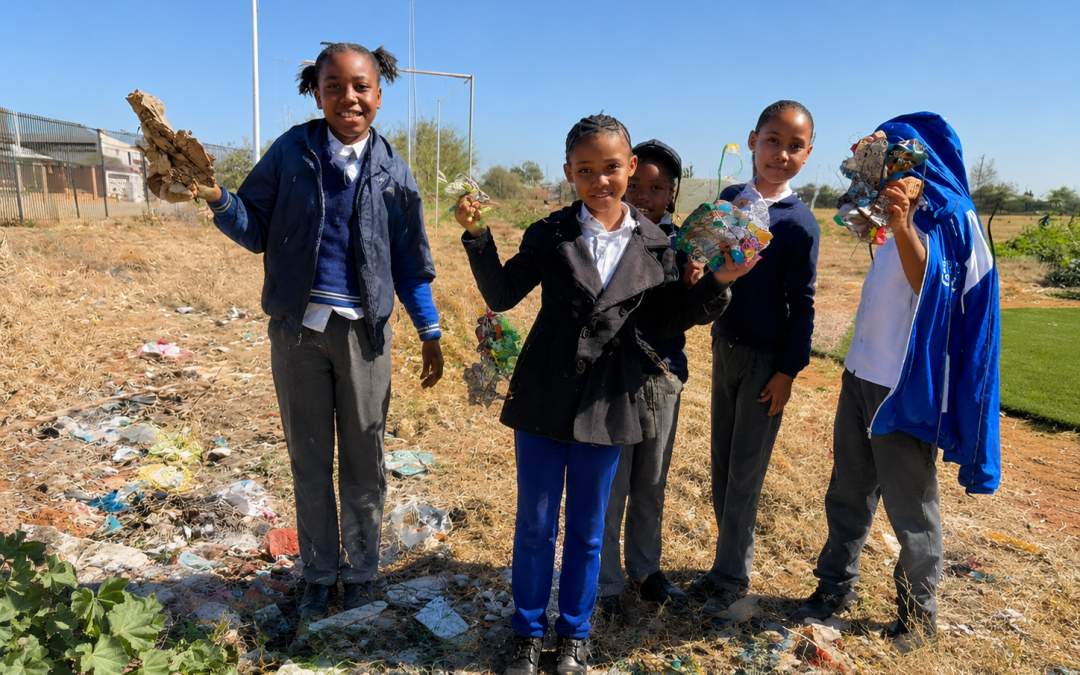
At Beacon Primary, learners have set up a system to collect paper, cardboard, plastic bottles, cans and scrap metal from the school and surrounding community, sorted by the programme’s members into branded bins and bulk bags. A teacher coordinator arranges transport of the sorted materials to a Kimberley recycling facility, where they are either sold or reused by learners to make planters, pencil holders, jewellery, classroom decor, reusable shopping bags, seed bombs, natural crafts and stationery made from recycled paper.
Both schools’ programmes are designed to build learners’ understanding of soil health, composting, closed nutrient loops and responsible resource use — while reducing waste sent to landfill and extending the useful life of materials.
The programme, funded by Droogfontein Solar Power and delivered in partnership with WESSA Eco-Schools, includes teacher training, environmental education, eco-club establishment and most recently additional funding to provide all essential equipment and supplies needed to ensure these school enterprises are a success.
“The programme offers more than a school project; it’s early, practical experience in leadership, entrepreneurship and environmental stewardship, with classroom lessons now taking root on the schools’ own grounds. Simply put, we are helping to build learner-led green business opportunities,” said Harrisinah Theka, Economic Development Manager at Droogfontein Solar Power.
The solar farm has committed to longer-term support to help secure the programme’s success, including regular check-ins with the project coordinator, teacher coordinators and eco-clubs, ongoing teacher workshops, and monitoring of measurable outcomes such as waste collected, crops harvested and income generated.